
“Grounding” is often used as a therapeutic term, and implies connecting with our body, our breath, the ground and the present moment.
Grounding can support us to manage overwhelming emotions, anchoring us and bringing a feeling of safety to hold our feelings.
I also see grounding a little bit like accessing the nurturing part of us that can soothe and comfort the part of us feeling vulnerable and afraid, bringing an experience of wholeness to help process what we are experiencing.
Grounding techniques can be helpful in our everyday life when we are well, to connect with ourselves and function with greater awareness and authenticity. Grounding can also aid in recovery from a traumatic event such as bereavement, as we navigate our way onwards with our grief.
The science:
Physiologically, very simply: when we go through something very distressing, a part of the brain called the amygdala (that has been likened to a “smoke alarm” for detecting danger/threat) becomes activated and stimulates the sympathetic nervous system, releasing the hormones adrenaline and cortisol – the body’s stress and survival response.
Typically, our heart rate and breathing rate increases, our circulation changes to prepare us to face what is happening and our senses are heightened. We may have feelings of wanting to get away (flight), to aggressively confront (fight), or feeling immobile/unable to act (freeze). We may find ourselves appeasing to avoid conflict (fawn) or, on occasion, a shutdown response to protect us from the impact of trauma (flop).
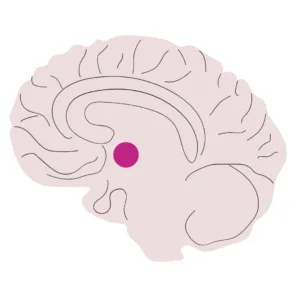 The amygdala, when activated, also suppresses the areas of the brain needed for rational thought and making meaning of things.
So when we are in this survival mode our frontal brain is largely “offline” in order to manage what is happening without being overwhelmed.
When things return to a less threatening state, our brain connects up again to process what we have been through. We are more enabled to feel the feelings and release them, and this is why we may then find more emotions surface some weeks/months later (or longer) after a traumatic experience.
This is the “adaptive information processing” model of the brain, and how we are built to recover from trauma, albeit to a new normal as our experiences change us and shape us.
We may always have our grief – that is a reflection of the love we carry for those we have lost – this is different to our trauma that in time we may carry more lightly without so much distress being triggered.
When we feel traumatised, distressing memories may still be held in the right side of the brain which, greatly simplified, is the creative, sensory side of the brain that has no sense of time. When the memories are processed to the left side of the brain (that is more linear and logical and has a sense of time) our trauma subsides. During this process of recovery, grounding techniques can be very supportive.
Examples of grounding techniques:
Lengthening the outbreath
Lengthening the outbreath (e.g. breathing in to a count of 4 and out for 6) stimulates the parasympathetic nervous system, triggering our body to calm down, slowing down our heart rate.
We always have the tool of our breathing – even one conscious deep breath and slow outbreath can help us relax.
Coming to the senses
Noticing what we can see, hear, smell, taste and touch right now in the room we are in helps us connect with the present moment.
Fear, anxiety and trauma are based in the past or the future: coming back to the present moment mindfully can reassure us we are safe in the moment and help us calm.
Physically feeling your feet on the ground
Imagining roots into the Earth from our feet, either seated and/or combined with meditation, or walking with awareness of feeling our heels on the ground, can be calming.
Relaxing the body
Exercise is a way to focus the mind and relax the body. Activities like yoga, tai chi and chi kung – with their holistic mind-body-spirit approaches – can be incredibly grounding.
Repeating affirmations
Developing self-compassion is the bedrock of resilience. Often we are hard on ourselves.
Finding an affirmation – a strength we can own about ourself – “I am loving” or “I am ok” or “I am good enough” – can help to repair our self-esteem.
Finding a transition object
An object that inspires a quality of strength or courage – for example a small pebble that fits in the palm of the hand and could be carried in a pocket – can be a physical reminder of our strength.
Meditating
There are many examples of meditation. When we visualise things, our brain responds in the same way as if they are really happening, so visualising something relaxing can have this effect.
A personal favourite is the safe space meditation – you can listen to this here.
Placing a hand on your chest
Simply bring one hand (or both) to the centre of the chest and sense the movement of the breathing with the hand/s and the chest, being aware of the presence of the hand.
This can be very soothing as the hands can represent the nurturing part of us and the chest may represent the vulnerable part, so this exercise can be self-soothing.
What I have learned about grounding has come from training as a midwife and supporting people in labour, and their supporters, to ground and calm. Other areas of my practice include pregnancy yoga teacher training with Janet Balaskas, my own yoga/meditation practice of 37 years, counselling training, EMDR training, attending training in Compassion Focussed Therapy with Dr Deborah Lee, and ‘trauma and the body training’ with Susi Wrenshaw.
 A useful book with lots of ideas and grounding techniques is Trauma Treatment Toolbox by Dr Jennifer Sweeton.
I hope you enjoy these ideas, and they serve you in some way in helping to navigate your path going forwards.