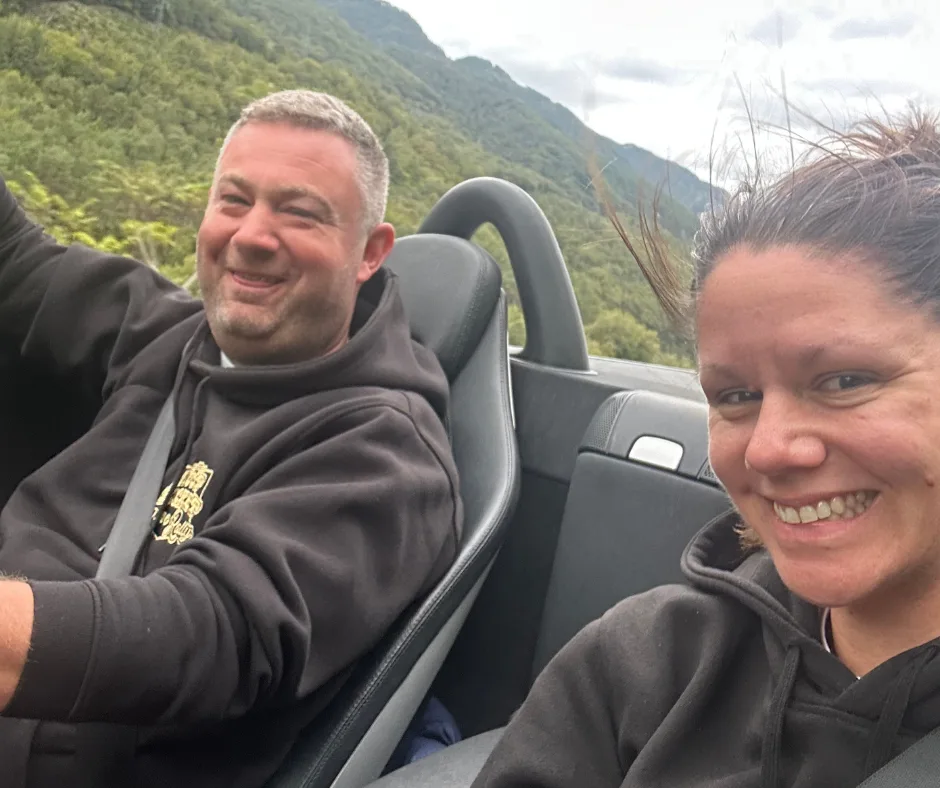
Ten years after their first loss and countless moments of “it’s just not happening,” Rosie and Pete embarked on their IVF journey with hearts full of cautious hope. Hoping to finally hold the child they’d been dreaming of for so long.
Instead, they found themselves ‘in stunned silence’, clutching a scan photo they’d barely had time to look at as they navigated the heartbreak of miscarriage. Read their story of finding comfort in community and raising an incredible amount of money to support others, through The Rust Bucket Rally.
 The IVF Journey
“Our first transfer wasn’t successful,” Rosie shares. “When we saw that negative pregnancy test, it was difficult, but we’d tried to prepare ourselves mentally. The doctors had been clear about the success rates, and at 39, I knew the odds weren’t necessarily in our favour.”
But hope has a way of persisting. Their second transfer felt different from the start, carrying with it a sense of possibility that seemed to whisper, “This time.” An eight-week scan revealed a strong heartbeat, and for a brief, beautiful moment, everything they’d dreamed of seemed within reach.
When Joy Turns to Heartbreak
The morning of their 12-week scan changed everything. What should have been a day of celebration became a blur of bleeding, sterile hospital rooms and those devastating words no parent wants to hear: “I’m so sorry… There’s no heartbeat.”
“We were moved from room to room,” Rosie recalls. “The lack of compassion still stays with me. I remember one nurse taking away our maternity book – the one you expect to fill with precious milestones – saying simply, ‘You won’t need this anymore.'”
These small moments of disconnection would later fuel their determination to ensure other couples wouldn’t face the same isolation.
Lost in the System
What followed was a maze of confusion: a list of possible medical procedures, a freezing cold waiting room, and instructions that seemed to miss the human element of their loss that had only been identified moments prior.
“We left the hospital having taken a tablet, with a leaflet about the medication, and a scan photo in a brown envelope we hadn’t even looked at,” Rosie shares. “We were told to come back in two days time for a medical management, despite my explaining that I was already bleeding. The only guidance was ‘Go to A&E if the bleeding gets worse.’ That was it.”
Rosie and Pete decided, to bring some normality to the day, to go for lunch.
“Then the bleeding really, really kicked in and I thought, we need to go home. We need to go home right now. And so we thought we’ll just have a rest and play it out and then, unfortunately, it all happened at home.”
Following a traumatic and painful miscarriage at home, they were directed to A&E by the midwifery team.
On a sweltering day, they found themselves in a crowded emergency department. “Every time we moved to a different area, we had to retell our story,” Rosie shares. “Imagine having to repeat the most heartbreaking moment of your life over and over, sitting among people with sunstroke and minor injuries.”
The final indignity came after 8 hours in A&E, around midnight when, after being told everything was “clear” – as if that was somehow good news – they were simply sent home. No follow-up appointment. No support information. No guidance for what came next. “Our world just stopped; it was like driving at 100mph and screeching to a halt in an instant.”
Finding Their Way Through Grief
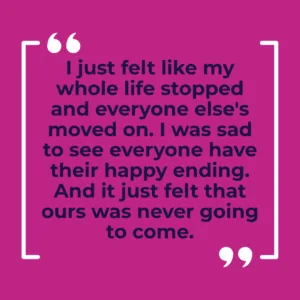
“Grief doesn’t follow a timetable,” Rosie reflects. “I found myself crying at random moments for weeks after. We tried to just carry on, but then I would break down and scream to Pete, “I just want our baby back”. I was angry, thinking ‘why us?’ and all I could see and hear was happy families. It felt like our world had stopped while everyone else’s kept turning.
But Pete… Pete needed to fix things. That’s who he is. A practical hands-on problem solver. If something is broken, he fixes it. But this couldn’t be fixed… So that’s when he decided to help others instead.”
The Rust Bucket Rally: Finding Purpose in Adventure
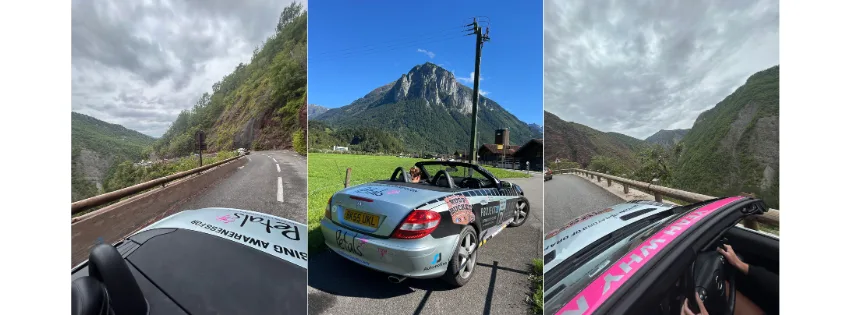
Enter the Rust Bucket Rally – a 2,500-mile adventure through five European countries in four intense days, in a car worth less than £1,000.
Pete had been involved with the Rust Bucket Rally previously and asked the question: “Why don’t we go? And why don’t we find a charity that supports people who’ve been through what we’ve been through?”
“And that’s when we found Petals.”
What started as Pete’s way of channelling their grief became Team “Yeah, Why Not,” their vehicle proudly displaying the Petals logo.
“Starting at 2am on a Friday morning,” Rosie explains, “we drove for at least 11 hours a day, racing between checkpoints. There were quirky rules – like keeping convertible roofs down regardless of weather (yes, we got soaked in the rain!). Our car developed quite a personality along the way, complete with a distinctive squeak on the journey home.”
 The rally created unexpected moments of connection and healing. Other teams shared their own stories of loss, hope, and resilience during pit stops and evening gatherings.
“It wasn’t just about the driving,” Rosie reflects. “It was about finding our community. Every team had their reason for being there, their charity they were supporting. People opened up about experiences they’d never shared before.”
For Pete, the practical challenges of sourcing, buying, designing the livery and keeping their budget car running provided a welcome distraction from grief, while the long hours on the road gave the couple time to talk, laugh, and remember how to find joy again. The Petals logo on their car, initially a source of apprehension, became a badge of honour – a visible symbol of their willingness to break the silence around pregnancy loss.
Through the challenge of navigation, mechanical issues, and sleep deprivation, they found something unexpected: healing. Their successful fundraising of over £2,000 proved that their personal tragedy could become a source of hope for others facing similar journeys.
Rosie and Pete have one embryo still frozen, a practical reminder that, for many, starting a family isn’t simply an emotional choice to make. For now, they continue to navigate their grief and return to ordinary life. Through their incredible fundraising and bravely telling their story, they hope to change how others will be supported when they need it most.